
How big is the eDNA operability gap?
This research will test where and how eDNA for biosecurity detection might be implemented on orchards/farms. Research will be split into two aspects, with substantial overlap: (1) eDNA detection from fruit in post-harvest; (2) eDNA detection from plant leaves in the orchard.
Post-harvest kiwifruit is a potential collection point for eDNA, due to an absence of chlorine washes. eDNA analysis from packhouse kiwifruit brushings will be optimised based on our preliminary work. For reasons of market access, the target will be insect eDNA. Post-harvest detections will be correlated with eDNA results from pre-harvest fruit in the orchard.
A focus will be calibration and validation of untargeted, broad taxon eDNA data (including using nanopore sequencing) against secondary measures of organism presence. Comparisons will be made with species-specific insect qPCR assays applied to the eDNA. Potential model insects with known presence in kiwifruit orchards include the Passion vine hopper, Greenhouse thrips, scale and fruit fly species. Further corroborating orchard data will be via insect counts from yellow sticky traps and detached leaves.
A final comparative layer of data will be developed through insect-derived eDNA (iDNA). Trapped insects will be identified using high throughput barcoding techniques and the insect eDNA scanned for associated microbiology. This will give us additional measures of insect species presence and an assessment point for insect orchard interactions (e.g vectored plant pathogens).
Summary of our sample types and interactions between different forms of data
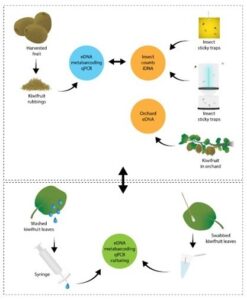
The cornerstone of orchard leaf screening will be comparison of two emerging, potentially high throughput, eDNA techniques. Leaf washing will build on our detection of insect eDNA, modified from aquatic eDNA research, and methods for epiphyte sampling. Leaf swabbing eDNA protocols (see collaborations) derive from established techniques in forensic analyses and require little specialised equipment [2]. Screening may also be applied to orchard tools, which are known eDNA accumulation points. With our end-users we will identify microbial species as models for unwanted kiwifruit leaf spot diseases. Untargeted microbial eDNA profiles from the leaves will be validated with specific qPCR assays. For further cross-referencing, we hold considerable institutional (PFR) data on culturable pathogen distribution in kiwifruit orchards, and substantial kiwifruit orchard eDNA datasets. Leaf eDNA will be screened for both microbial and insect species.
airDNA holds promise for capturing DNA dispersed across the orchard ecosystem [3, 4]. Aspects of airDNA collection will, if possible (see collaborations) be applied in this project.
Contact Project Leader Simon Bulman: [email protected]