
Could an alternative insect host be used in NZ to rear the most promising biocontrol agent for the brown marmorated stink bug?
This project is assessing the feasibility to establish and maintain a colony of Trissolcus japonicus, the most promising biological control for brown marmorated stink bug (BMSB) on an alternative host species, Monteithiella humeralis (an exotic stink bug), in the absence of BMSB in New Zealand. If successful, T. japonicus could be reared on the alternative host, enabling the production and supply of parasitoids within NZ for a potential incursion response for BMSB.
Halyomorpha halys, commonly known as the brown marmorated stink bug (BMSB), is a highly polyphagous pest and a serious biosecurity threat to valued native and crop plant species in New Zealand. As part of a preparedness BMSB project, a pre-emptive classical biocontrol programme for BMSB using its most promising biocontrol agent, the egg parasitoid Trissolcus japonicus (Samurai wasp), was initiated in 2015.
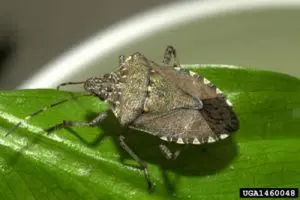
BMSB
Trissolcus japonicus is an oligophagous egg parasitoid that is known to attack a number of species within the families Pentatomidae and Scutelleriade, which means it potentially could be used as an alternative host when a preferred host (i.e., BMSB) is unavailable. Host specificity testing of T. japonicus conducted in NZ between 2016-2018 showed that % egg masses parasitized and % of parasitoids emergence was significantly high (>78%) in Monteithiella humeralis.
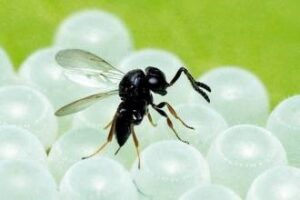
Samurai wasp
Rearing of parasitoid species using alternative hosts has been practiced for years, which includes Trissolcus species, however this has never been attempted for T. japonicus anywhere in the world.
Contact Project Leader Karina Santos: [email protected]